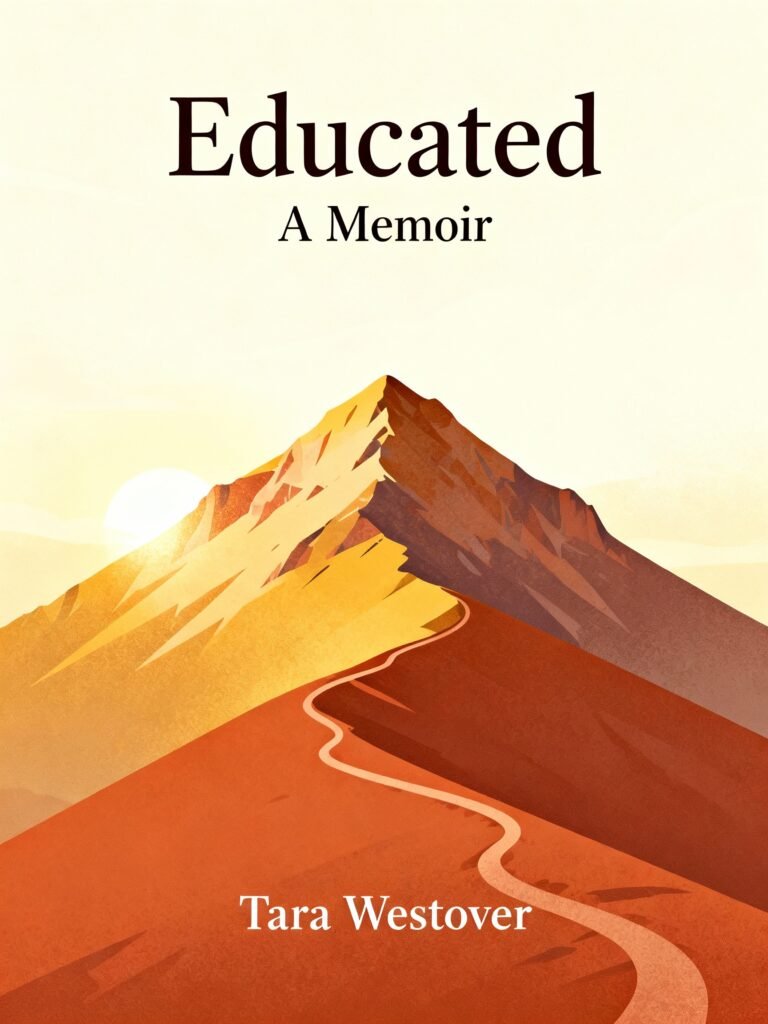

Have you ever wondered what it would take to completely rebuild your identity? What if the only education you received came from isolation, conspiracy theories, and survival in the wilderness? Tara Westover’s Educated is a haunting, unforgettable memoir that will shake the very foundations of how you understand family, faith, and the transformative power of learning. This is not just a story about education—it’s a story about choosing yourself when everything and everyone you love demands the opposite.
![Educated Tara Westover, Where the Crawdads Sing [Hardcover] 2 Boo...](https://m.media-amazon.com/images/I/51L2SGqbgjL.jpg)
Understanding Educated: Plot Summary and Core Themes
Educated chronicles Tara Westover’s extraordinary journey from a childhood of radical survivalism in rural Idaho to her emergence as a woman who educated herself against all odds. Born to a father who believed the government was coming to destroy their family and a mother who served as an unlicensed midwife in the mountains, Tara was one of four children without a birth certificate. She spent her early years preparing for the “Days of Abomination,” canning peaches and burying guns, never attending school or seeing a doctor.
The memoir is a masterclass in storytelling, blending intimate family moments with larger historical contexts. It opens with Tara as a young girl standing on a red railroad car near her family’s farm at the base of Buck’s Peak, watching a school bus pass without stopping. This single image captures the essence of her isolation: by age seven, she understands that not attending school is what makes her family different. Yet it also reveals the strange beauty and mythology of her father’s world—his stories of the “Indian Princess” mountain, his fierce independence, and his apocalyptic worldview all feel, to young Tara, like natural law.
The emotional arc of the book moves from Tara’s innocence and acceptance of her life as normal, through a series of traumatic events that force her to question her family’s beliefs, to her ultimate decision to leave and pursue formal education. This decision becomes almost revolutionary in its implications. When her grandmother finally offers to take her to Arizona for school, Tara chooses to stay—but the seed has been planted. Later, in her early teens, she makes the leap that will define her life: she teaches herself enough to pass a college entrance exam and enters Brigham Young University, arriving at the university completely unprepared but intellectually hungry.
What makes Educated particularly compelling is how Westover doesn’t sanitize her family’s story for easy consumption. Her father, Gene, is portrayed as a man of contradictions—charismatic and brilliant, yet increasingly unraveled by paranoia and conspiracy thinking. Her mother, Faye, is both a victim and a collaborator, choosing her husband’s increasingly dangerous ideologies over her children’s wellbeing. The portrait of these family dynamics is rendered with remarkable nuance. We see how ideology can distort even love, how parents can harm their children without malice, and how the most intimate bonds can become prisons.
One of the book’s most devastating threads involves her older brother Shawn, who becomes increasingly violent, physically and sexually abusive to Tara and others. What’s particularly cutting is how her father’s worldview—his belief that he and his family are locked in an apocalyptic battle against the government and modern medicine—creates a context in which this abuse is rationalized, minimized, or even spiritualized. When Tara confides in her bishop about Shawn’s violence, she’s told that she should forgive him, that her brother is spiritual and is being attacked by Satan. The implication is clear: her safety is secondary to her brother’s redemption narrative.
At BYU, Tara experiences a different kind of education entirely. She encounters history, science, and ideas that contradict everything she’s been taught. She learns that the Holocaust happened (her father had taught her it was a hoax), that the Civil War was about slavery (not just states’ rights), and that her family’s worldview is not shared by the rest of the world. This cognitive dissonance drives her deeper into her studies, but it also pulls her further away from her family.
The memoir’s closing chapters grapple with the human cost of this transformation. Tara does not simply leave her family behind and walk into a triumphant new life. Instead, she finds herself caught between two worlds, belonging fully to neither. She must choose between her family and her education, between loyalty and truth. That choice haunts her. By the book’s end, she’s estranged from her father, and the rift feels less like liberation and more like a necessary tragedy.
Why You Should Read Educated
Educated speaks to anyone who has ever felt trapped by circumstance, ideology, or the people they love most. It’s particularly resonant for readers who understand how families can be prisons, how the people who raise us can shape our reality in ways that take years to unpack, and how difficult it is to forge a new identity when everything you’ve known is suddenly suspect.
The narrative voice is remarkable—Tara writes with the precision of a scholar and the vulnerability of someone still processing trauma. You can almost feel the author’s conviction as she unfolds each chapter, each revelation rendering her world smaller and then, paradoxically, infinitely larger. The writing is spare but lyrical when it needs to be. Her descriptions of Buck’s Peak and the mountains of Idaho have an almost mythic quality, which makes the violence and dysfunction that occurs within that landscape all the more jarring.
This book appeals to readers looking for a thoughtful exploration of several interconnected themes: the nature of education and its power to transform lives; the psychology of radical families and indoctrination; the tension between personal autonomy and family loyalty; and the very definition of what it means to be “educated” in the broader sense of the word. It’s for intellectually curious readers, yes, but also for anyone who’s ever had to question what they were taught by the people they trusted most.
Educated also resonates on a current, relevant level. In an era when misinformation, conspiracy theories, and ideological echo chambers are increasingly prevalent, Westover’s memoir offers a searing first-person account of how otherwise intelligent, well-meaning people can construct elaborate belief systems that are divorced from reality. It’s not preachy—Westover lets her story speak for itself—but it’s an urgent reminder of the stakes involved when people retreat from the wider world.
The Key Takeaways from Educated
The central lesson of Educated is that education—true education—is not just about acquiring information. It’s about developing the capacity to think critically, to question your assumptions, to distinguish between what you’ve been told and what you can verify. For Tara, education becomes a tool of liberation, but that liberation comes with a profound cost.
Another critical takeaway is that trauma and indoctrination are often invisible until you step outside them. Tara doesn’t initially see her childhood as abusive or restrictive; it’s normal to her. It’s only when she encounters other ways of living and thinking that she begins to recognize patterns of harm. This is a sobering reminder that the most effective forms of control are often the ones we don’t recognize as control.
The book also illuminates the tension between loyalty and truth. Tara is not presented as heroic for leaving her family; instead, she’s presented as someone caught in an impossible situation, trying to hold onto both her identity and her integrity, and discovering that she cannot do both. This is more honest than many memoirs, more tragic, and ultimately more moving.
Who Will Love This Book
This book is ideal for readers who appreciate memoirs that tackle difficult family dynamics with honesty rather than melodrama. It’s perfect for anyone interested in the intersection of religion, ideology, and family; for educators and students wondering what education really means; and for readers who’ve ever had to reconcile love with disappointment, family loyalty with personal truth.
Educated will resonate with anyone who has questioned their upbringing, struggled with family relationships, or felt caught between the world they were born into and the world they want to live in. It’s also a powerful read for anyone seeking to understand how smart, dedicated people can be trapped by belief systems that divorce them from reality. The pace is steady, the writing is elegant without being pretentious, and the emotional payload is significant enough that you’ll likely think about this book long after you’ve finished it. If you’re into Biography you may love this book.