Non-fiction Review
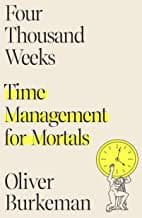
Four Thousand Weeks: Time Management for Mortals
by Oliver Burkeman
TL;DR
The average human life is about four thousand weeks long, and Oliver Burkeman argues that most time-management advice makes people miserable by promising a way to fit infinite ambitions into that finite span. Four Thousand Weeks rejects the productivity genre's core premise entirely, building a genuinely different, more honest case for accepting limits instead of optimizing around them.
What Is Four Thousand Weeks About?
Burkeman, a former productivity columnist, walks through why efficiency systems consistently fail to deliver the sense of control they promise — because getting better at managing time just reveals more things you feel obligated to do with it. The book argues for a different approach entirely: accepting that you'll never do everything, deliberately choosing what to neglect, and finding meaning in activities precisely because they're finite rather than despite it.
Who Should Read It?
This is for readers who've tried productivity systems, apps, and time-management frameworks and still feel behind — Burkeman's argument is specifically that the feeling of being behind isn't a systems problem to be solved, it's an inherent condition of finite life to be accepted. It's less useful for readers wanting concrete new tactics rather than a philosophical reframe.
Strengths
The book's central move — treating limitation as the condition to work with rather than the problem to eliminate — is a genuine departure from nearly every other book in its category, and Burkeman argues it with real philosophical rigor rather than just repackaging mindfulness clichés. The "four thousand weeks" framing makes mortality concrete and countable in a way that lands harder than abstract reminders to "remember you'll die someday."
Weaknesses
Readers who want actionable tactics alongside the philosophy will find relatively little here — this is a book of reframing, not a system to implement. Some chapters circle the same core argument from slightly different angles rather than building substantially new ground as the book progresses.
Verdict
Four Thousand Weeks succeeds precisely where most productivity books fail — by refusing to promise a solution and making a genuinely persuasive case that the search for one is the actual problem.
Disclosure: Ink Reservoir is reader-supported. When you buy through links on our site, we may earn an affiliate commission at no extra cost to you. As an Amazon Associate we earn from qualifying purchases.
Check price on Amazon