Non-fiction Review
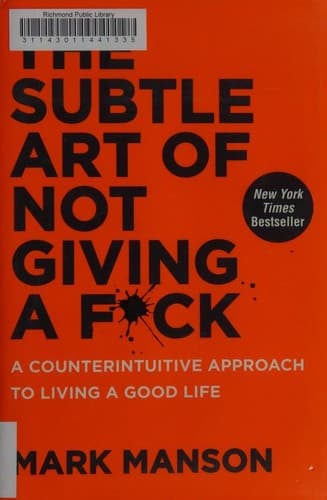
The Subtle Art of Not Giving a F*ck
by Mark Manson
TL;DR
Mark Manson argues that the pursuit of constant positivity is itself the problem — that a good life comes not from avoiding struggle but from choosing which struggles are actually worth caring about. The provocative title and profane voice are more marketing hook than the point; underneath them is a genuinely useful reframe of what self-help usually gets wrong.
What Is The Subtle Art of Not Giving a Fck* About?
Manson pushes back against the self-help industry's default assumption that happiness comes from wanting more, achieving more, and feeling positive constantly, arguing instead that people should deliberately narrow what they care about to a small set of genuinely important values, and accept the specific struggles that come with pursuing them. Chapters cover responsibility, failure, uncertainty, and mortality, using Manson's own personal losses and mistakes as recurring examples of the philosophy in practice.
Who Should Read It?
This is aimed at readers who've burned out on relentlessly upbeat self-help and want a more honest, values-clarification-first framework instead. It works especially well as an entry point for readers newer to personal-development reading who want something that doesn't read as saccharine.
Strengths
The book's central reframe — that avoiding struggle entirely isn't possible, so the real question is which struggles you actually want — is a genuinely useful corrective to self-help's usual promise of frictionless happiness. Manson's willingness to draw on his own specific failures and losses, rather than staying abstract, gives the philosophy concrete grounding.
Weaknesses
The provocative, profanity-forward voice does more marketing work than conceptual work — the ideas would hold up fine without it, and some readers will find the tone wears thin well before the book ends. A few middle chapters restate the central "choose your struggles" thesis in slightly different framing rather than genuinely building on it.
Verdict
Strip away the deliberately edgy packaging and The Subtle Art offers a real, useful corrective to positivity-obsessed self-help — the ideas are sturdier than the marketing suggests.
Disclosure: Ink Reservoir is reader-supported. When you buy through links on our site, we may earn an affiliate commission at no extra cost to you. As an Amazon Associate we earn from qualifying purchases.
Check price on Amazon