Non-fiction Review
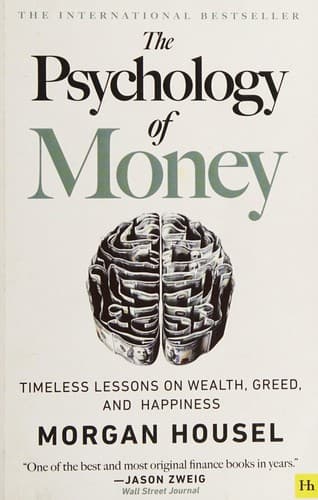
The Psychology of Money
by Morgan Housel
TL;DR
Morgan Housel argues that financial success has less to do with what you know about markets and more to do with how you behave — your relationship to risk, patience, and enough. The Psychology of Money is built almost entirely around behavior and temperament rather than tactics, told through short, essay-length chapters that are easy to absorb and revisit.
What Is The Psychology of Money About?
Rather than offering investment strategy or technical financial advice, Housel collects nineteen short essays on how psychology shapes financial outcomes: why people who know less about finance sometimes do better than experts because they behave more consistently, why "enough" is a harder concept than it sounds for people chasing more, and why compounding rewards patience over cleverness. Each chapter functions as a self-contained argument, illustrated with historical examples and personal anecdotes rather than technical analysis.
Who Should Read It?
This is for readers who want the psychological and behavioral foundation underneath good financial decisions, rather than a tactical guide to asset allocation or investment selection. It works well as an entry point for readers newer to personal-finance reading and as a useful reset for readers who already know the technical material but struggle with the behavioral side.
Strengths
The book's short, essay-length chapter structure is genuinely well-suited to its ideas — each argument is self-contained enough to revisit individually, which gives the book unusual staying power as a reference rather than a one-time read. Housel consistently prioritizes psychology and temperament over technical knowledge, which is a real and useful corrective in a genre that often overweights strategy and underweights behavior.
Weaknesses
Readers wanting concrete tactical guidance — specific asset allocation approaches, investment selection criteria — will find very little of that here; the book is deliberately about mindset, not mechanics. Some of the core ideas, particularly around compounding and staying invested through volatility, will be familiar territory for readers who've read other personal-finance books.
Verdict
The Psychology of Money earns its place as a modern personal-finance classic by focusing on the part of financial success — behavior — that most other books in the category underweight.
Disclosure: Ink Reservoir is reader-supported. When you buy through links on our site, we may earn an affiliate commission at no extra cost to you. As an Amazon Associate we earn from qualifying purchases.
Check price on Amazon