Horror Review
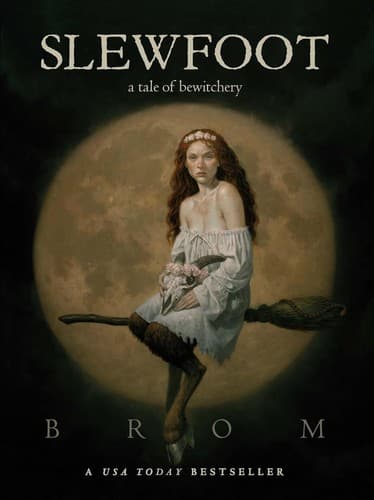
Slewfoot: A Tale of Bewitchery
by Brom
TL;DR
A young widow in 1666 Puritan Connecticut, accused of witchcraft by her own community, encounters a fallen forest god who offers her power in exchange for allegiance. Slewfoot is folk horror with real teeth — a visually striking, morally complicated novel about who actually deserves to be called a monster in a village already primed to accuse its own women.
What Is Slewfoot About?
Abitha, newly widowed and increasingly isolated by a Puritan community eager to blame her for every misfortune, meets a spirit the villagers would call a demon but who calls himself a forgotten god of the wild. As accusations of witchcraft close in around her, Abitha has to decide how far she's willing to go — and how much of herself she's willing to trade — to survive a community that's already decided what she is before she's done anything to earn the label.
Who Should Read It?
Readers who want folk horror grounded in real historical texture — the Puritan setting is researched with genuine specificity rather than used as generic gothic atmosphere. It's a strong pick for readers who want their horror morally complicated rather than a straightforward good-versus-evil showdown.
Strengths
Brom, also a professional illustrator, weaves his own artwork through the text, and the visual component genuinely deepens the atmosphere rather than feeling like a marketing add-on. The novel's central relationship — between Abitha and the forest spirit — refuses easy categorization; neither is purely heroic or purely monstrous, which gives the book's moral stakes real weight.
Weaknesses
The middle section, spent establishing the village's social and religious dynamics, slows the pace noticeably before the plot's darker turns arrive. Several of the Puritan antagonists lean closer to one-note religious-zealot caricature than the nuance Brom affords his two central characters.
Verdict
Slewfoot earns its place among the genre's better recent folk-horror entries by refusing to let either its heroine or its "monster" be simple.
Disclosure: Ink Reservoir is reader-supported. When you buy through links on our site, we may earn an affiliate commission at no extra cost to you. As an Amazon Associate we earn from qualifying purchases.
Check price on Amazon