Non-fiction Review
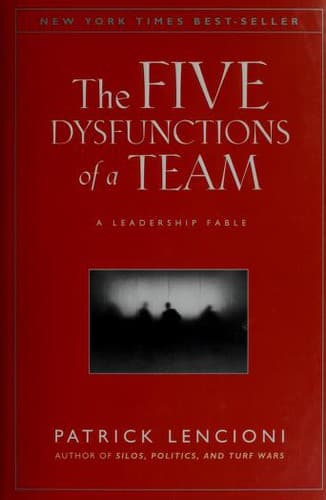
The Five Dysfunctions of a Team
by Patrick Lencioni
TL;DR
Patrick Lencioni delivers his team-dysfunction framework through a business fable — a fictional tech executive team failing for reasons that map onto five interlocking dysfunctions: absence of trust, fear of conflict, lack of commitment, avoidance of accountability, and inattention to results. The story format is a bigger asset than it sounds, making an otherwise abstract organizational framework genuinely memorable.
What Is The Five Dysfunctions of a Team About?
The book follows a fictional Silicon Valley company's new CEO as she diagnoses why her executive team isn't functioning, structured around a pyramid of five interrelated dysfunctions: teams without trust avoid conflict, teams that avoid conflict never reach real commitment, lack of commitment produces accountability avoidance, and all of that undermines collective focus on results. The second half of the book extracts the framework from the story into a standalone, practical model readers can apply directly.
Who Should Read It?
This is aimed at team leaders and managers trying to diagnose why a group isn't performing well together, especially readers who find dry organizational-behavior frameworks hard to retain. The fable format makes it a good fit for readers who want a business book that's actually quick and memorable to read, not just theoretically sound.
Strengths
The narrative fable structure is the book's smartest choice — abstract organizational psychology concepts stick far better wrapped in a story with characters making recognizable mistakes than they would as a dry framework alone. The five-dysfunction pyramid itself is genuinely useful: simple enough to hold in your head and apply to a real team, with each level's causal relationship to the next clearly argued.
Weaknesses
The fictional company and its executives are drawn thinly, existing mainly as vehicles for illustrating each dysfunction rather than as fully realized characters. Readers wanting detailed implementation guidance, rather than a framework and general principles, may find the fable format leaves some practical gaps.
Verdict
The Five Dysfunctions of a Team earns its two-decade shelf life by being genuinely more memorable and usable than most books in its category, precisely because it tells a story instead of just listing principles.
Disclosure: Ink Reservoir is reader-supported. When you buy through links on our site, we may earn an affiliate commission at no extra cost to you. As an Amazon Associate we earn from qualifying purchases.
Check price on Amazon