Non-fiction Review
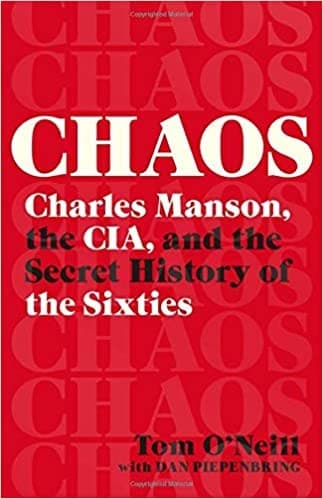
Chaos: Charles Manson, the CIA, and the Secret History of the Sixties
by Tom O'Neill
TL;DR
Journalist Tom O'Neill spent two decades investigating the Manson murders for what started as a magazine assignment, and ended up methodically dismantling large parts of prosecutor Vincent Bugliosi's official "Helter Shelter" narrative. Chaos doesn't fully prove its own alternative theory, but its documented skepticism of the accepted story is genuinely compelling.
What Is Chaos About?
Assigned to write a short retrospective piece on the Manson murders' 30th anniversary, O'Neill instead found inconsistencies in the official record that pulled him into two decades of increasingly obsessive research — interviews with surviving figures, court records, and previously unexamined documents suggesting connections between Manson, law enforcement, and intelligence programs that the official trial narrative never addressed. The book traces both the investigation itself and O'Neill's own personal and financial unraveling as the project consumed his life.
Who Should Read It?
Readers who've read or watched the standard Manson narrative and want a rigorously skeptical counter-investigation, rather than another retelling of the accepted story. It's a strong pick for readers who enjoy true crime that interrogates its own sources rather than accepting an official account at face value.
Strengths
The sheer volume of documented research — two decades, hundreds of interviews, extensive archival work — gives O'Neill's skepticism real evidentiary weight rather than reading as speculation. His willingness to include his own growing paranoia and financial collapse as part of the narrative gives the book an unusual, honest self-awareness about what obsessive investigation actually costs a person.
Weaknesses
Despite the exhaustive research, the book never fully proves an alternative theory to replace the official narrative it dismantles, which will frustrate readers wanting resolution rather than open questions. The sprawling structure, a direct result of two decades of scattered research, can feel digressive compared to a more tightly plotted true-crime narrative.
Verdict
Chaos is more valuable as a case study in investigative skepticism than as a solved mystery — and that's a genuinely worthwhile thing for a true-crime book to be.
Disclosure: Ink Reservoir is reader-supported. When you buy through links on our site, we may earn an affiliate commission at no extra cost to you. As an Amazon Associate we earn from qualifying purchases.
Check price on Amazon