Non-fiction Review
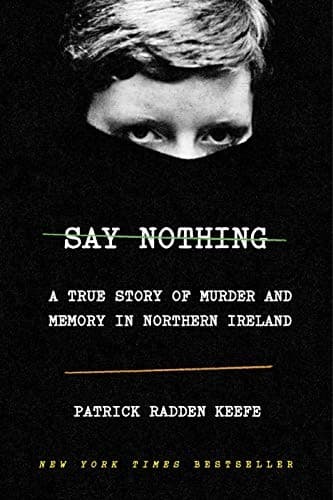
Say Nothing: A True Story of Murder and Memory in Northern Ireland
by Patrick Radden Keefe
TL;DR
In 1972, IRA members abducted Jean McConville, a widowed mother of ten, from her Belfast home; she was never seen again. Patrick Radden Keefe uses her disappearance as the entry point into a sweeping, meticulously reported account of the Troubles, tracing the conflict's violence and its unresolved moral reckoning through the lives of the people who lived — and killed — through it.
What Is Say Nothing About?
Keefe reconstructs Jean McConville's disappearance and death alongside the parallel stories of IRA figures including Dolours Price, whose radicalization and later disillusionment trace the broader arc of the Troubles from armed struggle to an uneasy peace that left many of its crimes formally unresolved. Drawing on an extraordinary oral-history archive of taped interviews with former paramilitaries (originally meant to stay sealed until after their deaths), the book builds a portrait of political violence's human cost that extends well beyond any single crime.
Who Should Read It?
This is essential reading for anyone interested in the Troubles specifically or in how political violence gets remembered, denied, and eventually reckoned with more broadly. It rewards close attention — Keefe's cast of historical figures is large, and the book pays off best for readers willing to track relationships across its full length.
Strengths
Keefe's structural achievement is using one family's specific tragedy to open onto a genuinely comprehensive account of the Troubles without ever losing sight of McConville's individual humanity amid the larger political history. The Boston College oral-history interviews he draws on give the book firsthand testimony from people who committed violence and later had to live with having done so — material few other accounts of the conflict have had access to.
Weaknesses
The book's large historical cast, spanning decades and multiple paramilitary and political organizations, can be genuinely difficult to track without careful reading. Readers with no prior background in Irish or Troubles-era history may want to supplement with outside context to catch every political nuance Keefe assumes some familiarity with.
Verdict
Say Nothing achieves something rare in narrative nonfiction: it reads with a thriller's momentum while carrying the full moral weight of the history it's actually about.
Disclosure: Ink Reservoir is reader-supported. When you buy through links on our site, we may earn an affiliate commission at no extra cost to you. As an Amazon Associate we earn from qualifying purchases.
Check price on Amazon