Non-fiction Review
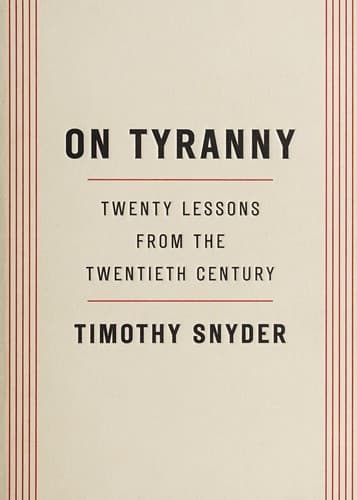
On Tyranny: Twenty Lessons from the Twentieth Century
by Timothy Snyder
TL;DR
Yale historian Timothy Snyder distills lessons from 20th-century authoritarian regimes — Nazi Germany, Stalinist Russia, and others — into twenty short, direct chapters aimed at general readers. On Tyranny is closer to a field manual than a traditional history book, and its brevity is the point: each lesson is a few pages of historically grounded, actionable guidance.
What Is On Tyranny About?
Drawing on his scholarly expertise in the history of Nazi Germany, Stalinist Russia, and other 20th-century authoritarian regimes, Snyder distills twenty specific lessons — "do not obey in advance," "defend institutions," "believe in truth" — each illustrated with concrete historical examples of how ordinary people either resisted or enabled authoritarian consolidation of power. The book is deliberately short and direct, written to be read quickly and referred back to rather than studied as a comprehensive academic history.
Who Should Read It?
This is for readers who want a concise, historically grounded set of principles rather than a comprehensive academic treatment of 20th-century authoritarianism. Its brevity makes it accessible to readers without a history background, while its specific historical grounding gives it more weight than a purely contemporary political commentary would carry.
Strengths
The book's concision is a genuine strength, not a limitation — each lesson lands with real clarity because Snyder doesn't dilute the argument with excessive elaboration. His scholarly background in the specific historical regimes he draws on gives the twenty lessons real historical weight rather than reading as generic civic advice.
Weaknesses
That same brevity means most historical examples get only a few sentences of elaboration, which will leave readers wanting deeper context reaching for further reading. The book's direct, prescriptive tone is closer to political intervention than neutral historical analysis, which some readers may find outside what they expect from history writing.
Verdict
On Tyranny succeeds at exactly what it sets out to do: translate specific historical lessons into short, actionable guidance without losing the historical grounding that gives the argument its weight.
Disclosure: Ink Reservoir is reader-supported. When you buy through links on our site, we may earn an affiliate commission at no extra cost to you. As an Amazon Associate we earn from qualifying purchases.
Check price on Amazon