Literary Fiction Review
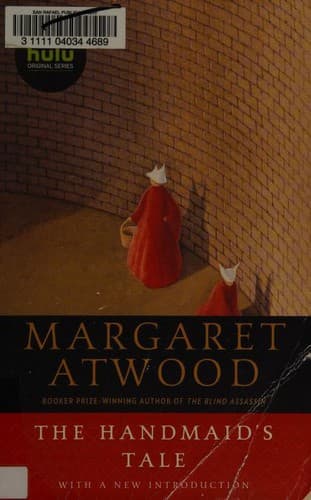
The Handmaid's Tale
by Margaret Atwood
TL;DR
Offred is a Handmaid in Gilead, a theocratic regime that has stripped women of names, property, and reproductive autonomy, forcing fertile women into ritualized sexual servitude to the ruling class. Told entirely from inside Offred's constrained perspective, The Handmaid's Tale remains the dystopian genre's clearest reference point, built on precision rather than spectacle.
What Is The Handmaid's Tale About?
After an unspecified crisis, a coup replaces the United States government with the Republic of Gilead, which responds to collapsing fertility rates by assigning fertile women — Handmaids — to high-ranking households for state-sanctioned reproduction. Offred narrates her days in one such household in fragments: the rituals she's forced through, her memories of her husband and daughter before Gilead, and the small, dangerous ways she and other women resist a system built to make resistance impossible.
Who Should Read It?
Readers who want the source text behind decades of dystopian fiction that followed it — the novel that established the genre convention of building horror through domestic detail rather than war-scale spectacle. It rewards patient readers willing to piece together Gilead's rules from implication rather than exposition.
Strengths
Atwood's structural choice to never let the reader outside Offred's head is the novel's defining strength — every rule of Gilead arrives filtered through what a woman inside the system is permitted to know, which makes the world-building feel earned rather than delivered. The prose's circling, associative rhythm does real psychological work, replicating the way trauma and surveillance actually distort memory and thought.
Weaknesses
The fragmented chronology and the novel's famously ambiguous ending are deliberate choices that some readers find genuinely frustrating rather than productively unresolved. Because so much of Gilead's mechanics are left implicit, readers expecting a fully mapped-out dystopia in the style of more recent genre entries may want to slow down and reread passages to track the rules.
Verdict
Forty years on, The Handmaid's Tale hasn't been surpassed as a model for how dystopian fiction can work from the inside out — restrained, exact, and more unsettling for what it withholds.
Disclosure: Ink Reservoir is reader-supported. When you buy through links on our site, we may earn an affiliate commission at no extra cost to you. As an Amazon Associate we earn from qualifying purchases.
Check price on Amazon